

Advanced weapons are pouring into Sudan, fueling a ruinous civil war and endangering security across the region, according to an analysis of recently seized arms caches viewed by Washington Post reporters, interviews with officials and a confidential report from independent experts that was shared by Sudan’s intelligence agency.
Paramilitary fighters now possess antiaircraft weapons that could threaten civilian air traffic, drones strikingly similar to those used by Yemen’s Houthi rebels and what appears to be a sophisticated Chinese surface-to-air missile system – altering the dynamics of the battlefield, analysts say, and prolonging a conflict that is likely to have claimed hundreds of thousands of lives.
What began as a power struggle between Sudan’s two most powerful men has devolved into a sprawling, hellishly complex war that analysts say threatens the long-term security of countries well beyond its borders. It has sucked in fighters from Libya, Chad, Mali, South Sudan and the Central African Republic – even from Colombia – along with weapons that came from Turkey, Iran and the United Arab Emirates.
“In 10 years, American and European leaders are going to regret their inaction on Sudan,” said Justin Lynch, the managing director of Conflict Insights Group. “A failed state on the Red Sea that is awash with predatory Islamist militias, advanced weapons and genocidal leaders will imperil the region for generations.”
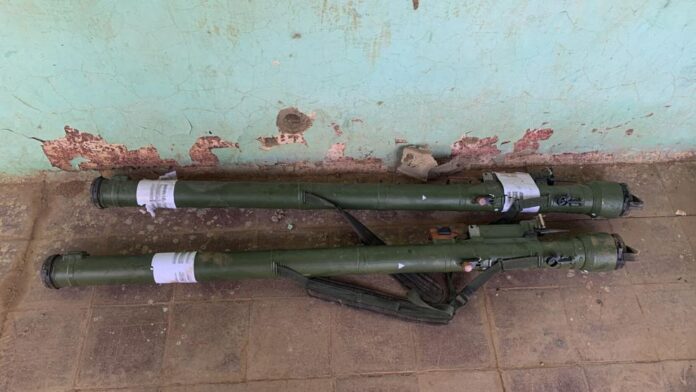
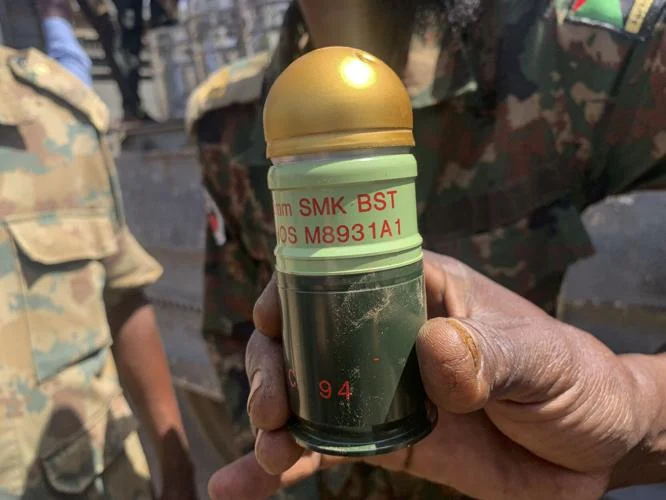
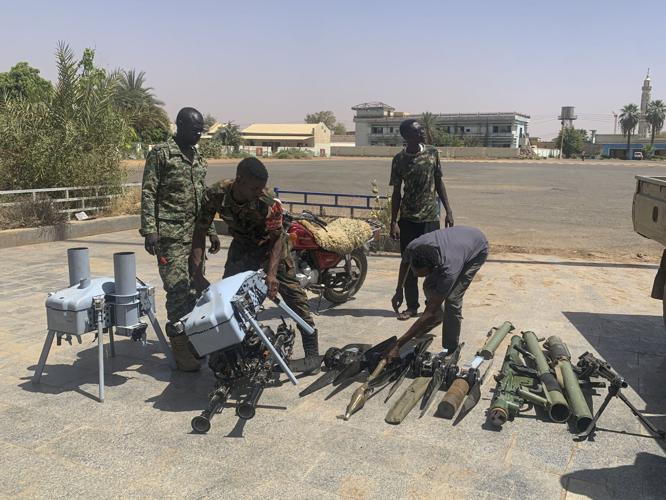
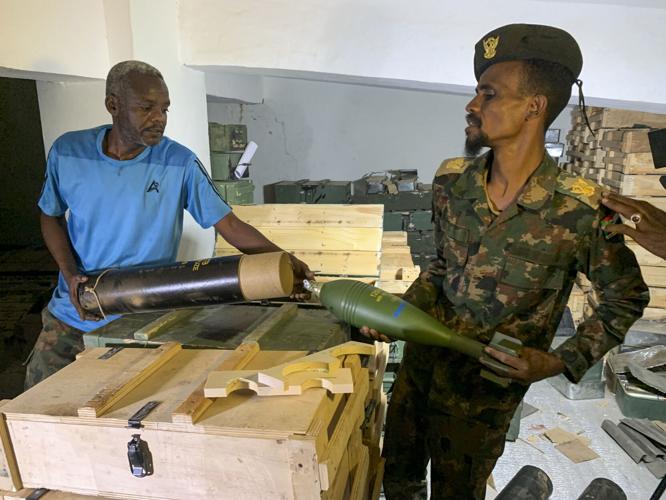
On a recent trip to Sudan, a Post reporter saw piles of weaponry that the military said was abandoned by the Rapid Support Forces (RSF) paramilitary during their retreat from the Sudanese capital of Khartoum. There were SA-7s – a type of Man-Portable Air Defense System (MANPADS) – drones, jamming equipment, guided anti-tank missiles, 120mm mortar shells, and truckloads of ammunition and 40mm phosphorus rounds, many still in their original packaging.
The RSF – accused by the United States and United Nations of war crimes and crimes against humanity – also appear to have acquired a truck-mounted antiaircraft system manufactured in China, Sudanese security officials said, and drones that bear the hallmarks of those produced by the Houthis, according to the confidential report. The report was prepared for Sudan’s General Intelligence Service by Conflict Armament Research (CAR), a British company whose work tracking the flow of illicit weapons is often cited in international sanctions decisions.
Multiple rounds of international sanctions on the RSF and the Sudanese military – which the U.S. has sanctioned for using chemical weapons – as well as a 2004 U.N. arms embargo on Darfur have done virtually nothing to contain the arms race. And as the front lines shift, antiaircraft weapons have been abandoned, raising concerns that they could be turned against civilian aircraft – or trafficked across the porous borders of the Sahel, home to numerous militant groups aligned with al-Qaeda and the Islamic State.
Presented with The Post’s findings, Sen. Jeanne Shaheen (New Hampshire), the leading Democrat on the Senate Foreign Relations Committee, called for more robust enforcement of the U.S. arms embargo and new sanctions on companies profiting from the conflict.
“The flow of weapons into Sudan is fueling this devastating war,” she said, “and the international community must do more to stop it.”
A battle to control the skies
Sudan’s war erupted in April 2023 when the head of the military and the head of the rival RSF, who had cooperated to overthrow a fragile civilian-led government, turned on each other. The war has created the world’s biggest humanitarian crisis: Half its population needs food aid, famine and cholera are spreading, and more than 12 million have fled their homes, the U.N. says.
In May 2024, the U.S. envoy for Sudan put the death toll around 150,000; there have been no credible updates in the 16 months the killing has gone on, and access to the country has narrowed.
The State Department has accused both the military and RSF of crimes against humanity. Children have been raped, enslaved and forced to fight. Hospitals have been obliterated. Community volunteers have been tortured and killed. More than a quarter of a million people face starvation and constant RSF bombardment in the besieged city of El Fashir.
The fighting has been marked by a rapid increase in the sophistication of weapons technology on both sides. In the first year of the war, despite RSF attacks on government jets, the military retained air superiority. It often bombed civilian neighborhoods and markets in areas under RSF control – and still does – killing fighters and families alike.
Within months, the RSF began attacking the military using new suicide drones and quadcopters, some carrying mortar shells that appeared to have originally been sold to the United Arab Emirates. In early 2024, on a trip to Khartoum, the military showed a captured drone and mortar shells to The Post; labels on the mortar shells’ boxes indicated they had been purchased by the UAE’s Armed Forces Joint Logistics Command. When reporters returned to the Sudanese capital in May, they saw more of the same type of mortar shells in a newly abandoned RSF stockpile; this time, the labels were obscured with black paint.
A cache of 81mm mortar shells seized from an RSF convoy in November were manufactured in Bulgaria, which later told U.N. investigators it had exported them to the UAE, Reuters reported. In 2024, the Emiratis built an airfield in neighboring Chad for the RSF to use as a launchpad for drones, pretending it was a humanitarian hub, the New York Times reported.
The UAE is heavily invested in Sudan’s gold mines and agricultural tracts, and it has long-standing ties to the RSF leader, who helped send Sudanese mercenaries to fight in Yemen’s civil war. Emirati authorities are also wary of Sudan’s Islamist military leaders – traditionally affiliated with the Muslim Brotherhood, which the UAE considers a terrorist organization.
“We categorically reject any claims of providing any form of support to either warring party,” the Emirati foreign ministry said in a statement to The Post.
As Sudan’s air war intensified last year, the military purchased top-of-the-line drones directly from Baykar – Turkey’s largest defense company – an upgrade to its existing fleet of armed Iranian drones. The new drones played a key role in the military offensive to retake the capital, which culminated in March.
Now, it seems, the RSF has a way to counter them. In the past two months, the group has shot down at least three of the military’s Turkish drones, according to footage posted online by paramilitary fighters and analyzed by experts at The Post’s request.
In one shoot-down video, the payload and wingspan of the downed drone matches the Akinci, Baykar’s most advanced model; in another video, a dual engine resembling those that power the Akincis is visible, according to Wim Zwijnenburg, the humanitarian disarmament project leader for PAX, a Dutch organization focused on protecting civilians in armed conflict.
None of the drones shot down were loitering, which would have made them easier targets, according to a former regional security official who remains in touch with parties to the conflict, speaking, like others in this story, on the condition of anonymity to share sensitive details. Two, he said, were above 20,000 feet.
“The technical proficiency that you are seeing is beyond RSF normal capabilities,” he said. “And all those systems are mobile.”
“You could get one lucky shot” with a shoulder-mounted missile, said a former U.S. official with experience in the region, but several would be unlikely, indicating “more advanced air defenses.”
A Sudanese security official told The Post that the RSF used a Chinese FK-2000 truck-mounted antiaircraft system to take down the drones. And a TikTok video posted by an RSF fighter after a shoot-down on Sept. 14 shows a rocket booster matching those used on the FK-2000 missiles, according to Jeremy Binnie, the Middle East defense specialist for Janes, a defense intelligence company.
There’s no record of an FK-2000 being sold to Sudan, but the Paris-based news service Africa Intelligence reported in April that the UAE donated two such systems to Chad last year.
Chad’s government spokesperson, Gassim Chérif, did not respond to a request for comment, and the Emirati Foreign Ministry did not respond to questions about the FK-2000.
‘A critical concern’
Sudan was already awash with less advanced, but still dangerous, antiaircraft weaponry. In May, The Post saw shoulder-mounted surface-to-air missiles, often called MANPADS, including SA-7s, in a substantial RSF stockpile captured by the military after retaking Khartoum.
The SA-7s were so new they were still in paper wrapping, though there were no labels identifying their place of origin. Since 1975, MANPADS missiles have hit 40 civilian aircraft, causing more than 800 deaths globally, according to the U.S. State Department.
In its report for Sudan’s intelligence service, Conflict Armament Research documented 19 surface-to-air missiles that the military said it had recovered from the RSF, manufactured in both China and Bulgaria.
“Proliferation of MANPADS is a critical concern to the international community,” CAR said in its report. The group declined to comment for this story.[metaslider id=81515]
Sudan’s intelligence service also declined to comment, but a consultant who works with the head of the agency told The Post that “all procedures that are necessary have been taken to rapidly secure any abandoned deadly weapons that can be used against airplanes … or to threaten international security or civilian life.”
Seized RSF stockpiles also contained six one-way-attack, or “suicide,” drones manufactured in late 2023 and 2024, “very similar in construction to those produced and assembled by the Houthis,” the report said. The drones could have been trafficked by boat across the Red Sea, the authors wrote, or acquired by the RSF through connections made while fighting in Yemen.
For more than two years, the Houthis have launched strikes on Israel and on shipping lanes in the Red Sea, citing support for Palestinians in Gaza. The militant group is supported by Iran, which also backs the Sudanese military.
That nonstate actors can use armed drones to launch attacks thousands of kilometers from the front lines “shows how difficult it will be to contain conflict in the next few decades,” said Lynch, from Conflict Insights Group.
“Neither the global community nor the United States are doing nearly enough to stem the onslaught of foreign weapons and support going into Sudan,” Sen. Chris Van Hollen (D-Maryland) told The Post. “The U.S., the U.N. and other international monitors should be calling more attention to this matter.”

