

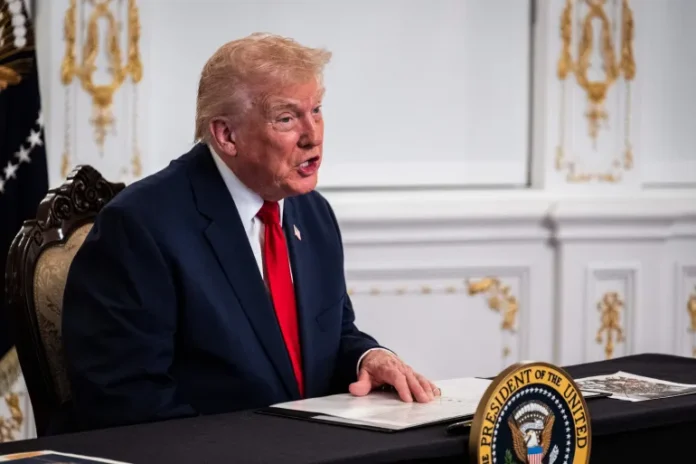
This is not the first time Donald Trump has made offensive statements about immigrants, but his latest attack on Somalis has been described as his most racist yet, after he labeled them “filthy” and “trash.” Since returning to office in January of last year, Trump has made immigration enforcement a top priority, deploying federal agents to major U.S. cities to track down undocumented immigrants and rejecting asylum seekers at the Mexican border.
Trump’s latest remarks, which insulted Somalia, sparked a wave of anger in Mogadishu, after he asserted that the United States does not want Somali migrants.
“They come from hell and complain”
Speaking at the end of a Cabinet meeting at the White House on Tuesday, the U.S. president said about Somali immigrants:
“They come from hell, they complain, and they do nothing but whine. We don’t want them in our country. Let them go back where they came from and fix it.”
Focus on Ilhan Omar
Trump also took aim at Ilhan Omar, the Democratic congresswoman from Minnesota who arrived in the United States as a Somali refugee 25 years ago and later became a U.S. citizen. He said she was “trash, and her friends are trash.”
He added: “We can go one way or another, but we’ll be on the wrong path if we keep letting trash into our country. These are not people who say, ‘Let’s rise up and make this a better place.’”
Disturbing use of vulgar language
The New York Times commented: “Even for a president long known for his demeaning rhetoric about immigrants, this attack on Somalis represented a deeply troubling use of vulgar language against an entire community.”
The remarks came amid a corruption scandal that surfaced in Minnesota, allegedly involving forged invoices linked to some members of the Somali community.
During the Cabinet meeting, Trump said Somalis “have nothing in their country and kill each other,” adding that “their country is in terrible shape—and there’s a reason for that. Their country stinks. We don’t want them here.”
Reactions
The Somali government has not issued any official statement, apparently seeking to avoid tension with Washington, which continues to provide vital security and humanitarian assistance to Somalia, according to French media reports.
However, many Somalis reacted angrily in the streets of Mogadishu. Daud Bari, a grocery store owner, described Trump’s comments as “offensive beyond measure” and called on the government to respond publicly and reject the insults.
Somaya Hassan Ali, a 23-year-old university student, described Trump’s words as “rude,” noting that the United States itself “has large numbers of murders every year—sometimes more than those in Somalia.”
Some criticized Somali President Hassan Sheikh Mohamud for his silence, while others saw that he had limited options. University lecturer Mahdi Ibrahim explained that the Somali government depends on U.S. support in its fight against militant groups, meaning any confrontation with Trump could prompt him to suddenly cut off that aid, as happened in past cases.
Nuruddin Abdi, a civil society worker, expressed a less hostile view: “Trump’s tone may be rude toward Somalia, but we can’t ignore the fact that much of what he says about Somalia is true,” he said.
He added that the country remains mired in conflict, corruption, and instability, stressing that improving Somalia’s global image must begin with “fixing governance and reducing chaos.”
Trump administration suspends immigration requests from 19 countries
Following last week’s shooting incident in Washington, the Trump administration announced the suspension of immigration requests from nationals of 19 countries.
The freeze applies to citizens of countries already subject to a partial entry ban announced in June, imposing even stricter immigration limits—a key element of Trump’s political agenda.
The list includes Afghanistan and Somalia. The official memorandum announcing the new policy cited last week’s attack on two members of the National Guard in Washington, for which an Afghan suspect was arrested. One of the two officers died, while the other was seriously injured.
The targeted countries—listed in the memo issued Wednesday—include Afghanistan, Burma, Chad, the Republic of the Congo, Equatorial Guinea, Eritrea, Haiti, Iran, Libya, Somalia, Sudan, and Yemen. All are subject to the toughest restrictions announced in June, including a full entry suspension with certain exceptions.
Other countries in the memo, already under partial restrictions since June, include Burundi, Cuba, Laos, Sierra Leone, Togo, Turkmenistan, and Venezuela. The new policy suspends pending applications and requires all migrants from the listed countries “to undergo a renewed, thorough vetting process, including possible interviews or re-interviews to fully assess any threats to national security and public safety.”
The memo also cited several recent crimes allegedly committed by migrants, including the attack on the National Guard.
Al-Yurae / France 24 / Reuters

