

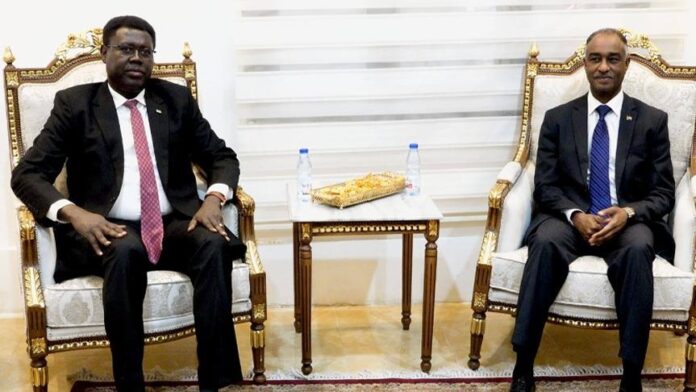
Sudan and South Sudan have agreed to facilitate the exchange of oil and commercial goods between the two countries by designating a free trade zone at Port Sudan on the Red Sea coast.
The decision was announced Tuesday in a joint statement issued at the conclusion of a four‑day visit to Sudan by a delegation from South Sudan led by Presidential Adviser Tut Gatluak.
According to the statement, “the two sides agreed to facilitate imports and exports in the oil and other commodity sectors through the establishment of a free zone in Port Sudan in eastern Sudan.”
The discussions were described as “productive talks aimed at strengthening cooperation, consultation, and coordination between the two countries across various oil‑sector activities.”
The statement added that the agreement covers the securing, operation, and management of oil fields in the Heglig and Bamboo areas of West Kordofan State, southern Sudan.
Both countries also committed to revitalizing joint committees, expanding strategic partnerships, and exchanging political and diplomatic support in regional and international forums.
In addition, the agreement includes steps to strengthen banking and financial channels between Khartoum and Juba and to reinforce their joint contribution to peace and stability in both nations.
Context of the agreement
The announcement follows the Rapid Support Forces (RSF) seizure of the Heglig oil field on December 8, and comes days after South Sudan’s government revealed it had reached an arrangement with Sudanese authorities and the RSF under which the South Sudan People’s Army would protect oil facilities in the area.
South Sudan’s crude exports flow through a 1,610‑kilometer Sudanese pipeline, originating from the border region of Heglig, which currently produces about 50 percent of Sudan’s oil output, and ending at Port Bashayer on the Red Sea.
On Monday, the RSF announced full control over the Heglig field, claiming it was “securing and protecting vital oil infrastructure to safeguard the interests of the Republic of South Sudan.”
In November, Sudanese authorities accused the RSF of launching drone attacks on the Juba Oil Processing Station in al‑Jibaylin, White Nile State, temporarily halting oil exports.
Ongoing conflict and displacement
Meanwhile, heavy fighting continues across the three Kordofan states North, West, and South between the Sudanese Armed Forces (SAF) and the RSF, displacing tens of thousands of civilians.
Since April 2023, the conflict between the RSF and the military triggered by disputes over the country’s post‑coup transition has plunged Sudan into one of the world’s worst humanitarian crises, with tens of thousands killed and an estimated 13 million people displaced.
The RSF now controls all five states of Darfur in western Sudan, except for parts of North Darfur still held by the army. The Sudanese Armed Forces dominate most of the remaining 13 states, including Khartoum, while vast parts of southern, northern, eastern, and central Sudan remain under military authority.
Darfur alone accounts for about one‑fifth of Sudan’s total land area, which exceeds 1.8 million square kilometers, but the majority of the country’s roughly 50 million people live in regions under army control.
Source: Anadolu Agency

