

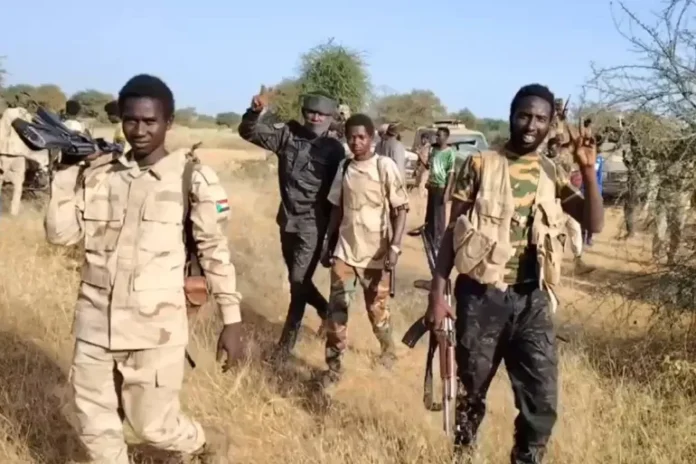
On Tuesday, the Rapid Support Forces (RSF) militia announced it had regained control of Al-Uba town southeast of Al-Ubayyid, the capital of North Kordofan State in central Sudan, just hours after the Sudanese army declared it had seized the area. The RSF also confirmed its rejection of a ceasefire initiative presented by Khartoum to the UN Security Council.
RSF commander’s advisor Pasha Tibik stated on his Facebook account that control over the strategically important Al-Uba had been restored, tightening the noose around Al-Ubayyid. This paves the way for capturing Rahad and Um Rawaba towns, severing the road linking western and central Sudan in this sector, and blocking any army incursion into South Kordofan State via this route.
A Sudanese army military source told Al Jazeera that the army had recaptured Al-Uba the previous day, inflicting heavy losses on the RSF during the operation and subsequently securing the town. Another army source reported to Al Jazeera that an RSF drone targeted Al-Dankuj town north of Al-Ubayyid.
Escalating Battles and Drone Warfare
These developments stem from clashes over recent days across multiple fronts. Direct clashes between the army and RSF have recently subsided in intensity, while drone strikes and counter-strikes have intensified at many combat sites.
On Monday, the Sudanese army used drones to target several towns in West Kordofan State where the militia is entrenched, destroying combat vehicles and neutralizing RSF fighters in areas including Abu Zabad, Abu Qalq, and Al-Mahfura.
The three Kordofan states (North, West, and South) have seen fierce fighting between the Sudanese army and RSF for weeks, displacing tens of thousands recently.
Strategic Implications
Military and strategic expert Colonel Hatem Al-Fallahi told Al Jazeera that controlling Kordofan would enable the Sudanese army to advance toward Darfur, as it serves as a central hub and transportation nexus that could become a mobilization area in the coming period.
Of Sudan’s 18 states, the RSF controls the five Darfur states in the west—except parts of North Darfur still held by the army—which dominates most of the remaining 13 states, including the capital Khartoum.
Humanitarian Crisis Worsens
The humanitarian suffering in Sudan has intensified due to the war between the army and RSF that erupted in April 2023, killing tens of thousands and displacing 13 million people.
Rejection of Ceasefire Initiative
Politically, RSF advisor Pasha Tibik rejected the ceasefire initiative proposed by Sudan’s transitional Prime Minister Kamil Idris to the UN Security Council on Monday. He called it a recycled exclusionary narrative, essentially no different from that of Sudanese Sovereignty Council President Abdel Fattah Al-Burhan.
In his Facebook post, Tibik said Idris lacks the will or authority to discuss stopping the war, let alone launch a substantive political initiative. He dismissed demands for RSF withdrawal from controlled areas and labeling it a militia as fanciful rather than political. Tibik stressed that ignoring Sudan’s historical crisis and structural distortions, along with excluding the other side as a partner, renders any initiative mere window dressing. Under Islamist Movement control, he added, Al-Burhan and Idris are mere tools for a specific political project unrelated to ending the war or building a just state.
Idris presented his government’s initiative to the Security Council, calling for a comprehensive ceasefire under international and regional oversight. Speaking to council members, he outlined reintegrating non-convicted former fighters into civilian life and urged a UN-African Union-Arab League monitored ceasefire, contingent on the rebel militia’s withdrawal from occupied areas and disarmament.
Path to Sudanese Dialogue
Idris called for Sudanese-Sudanese dialogue during the transitional period to agree on governance foundations, culminating in internationally supervised general elections. He expressed hope for “unconditional support” from Security Council members for this plan, described as complementary to the Saudi-US-Egyptian peace initiative.
In November, US President Donald Trump’s declared desire to intervene and end the war raised hopes for progress, but US-led talks with Egypt, Saudi Arabia, and the UAE have reached a deadlock.
Source: Al Jazeera + Agencies

