

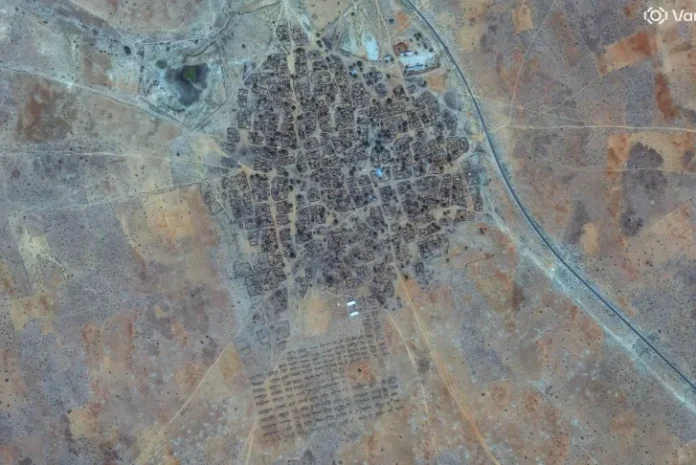
December 29 — A senior United Nations official said on Monday that international aid workers who entered the Sudanese city of El Fasher for the first time since it was seized by the Rapid Support Forces (RSF) found it largely deserted, with only a few people sheltering in buildings or under plastic sheets.
According to estimates, more than 100,000 people have fled El Fasher since late October, after the RSF gained control of the city following an 18‑month siege that pushed it to the brink of famine. Survivors reported ethnically driven mass killings and widespread detentions during and after the takeover. The fate of many residents remains unknown in the city and surrounding areas.
In an interview with Reuters, Denise Brown, the UN Resident and Humanitarian Coordinator in Sudan, described El Fasher as a “crime scene.”
Referring to the UN visit to the city on Friday, which lasted several hours, Brown said: “The city was not bustling with people. There were very few we could see.”
Negotiations over the UN’s requirements for safe passage and freedom of movement took weeks, despite efforts by the RSF to portray the city as having returned to normal shortly after its capture.
Few signs of life
Brown said it was impossible to determine the exact number of people remaining in El Fasher, adding that those seen by UN staff were living in abandoned buildings or makeshift shelters made of plastic sheets.
A small market was functioning but offered limited produce, mostly locally grown vegetables.
“We have images of people whose faces clearly show signs of exhaustion, anxiety, and loss,” Brown said.
Other aid workers have previously noted that those remaining in the city are likely the elderly, the sick, or the injured, unable to leave.
Satellite images captured on December 16 and analyzed by the Yale Humanitarian Research Lab showed signs of body removal, while evidence of human activity was scarce.
Brown said a medical team was observed at the Saudi Hospital, which the World Health Organization reported had been the site of a massacre that left 460 people dead, though medical personnel there had no supplies available.
She added that villages around the city appeared deserted.
Concerns over the wounded and missing
The assault on El Fasher represents one of the deadliest chapters of the conflict that has raged since April 2023 between the RSF and Sudan’s armed forces. The offensive enabled the paramilitary group to solidify its control over the Darfur region in western Sudan and expand its territory further into the northwest earlier this month.
Brown said the purpose of Friday’s visit was to assess whether safe access to El Fasher was possible as the UN considers options for delivering essential humanitarian aid.
“But frankly, we remain deeply concerned about the wounded—those we could not see—and those who may be detained,” she added.
She said subsequent missions would focus on water and sanitation issues.

