

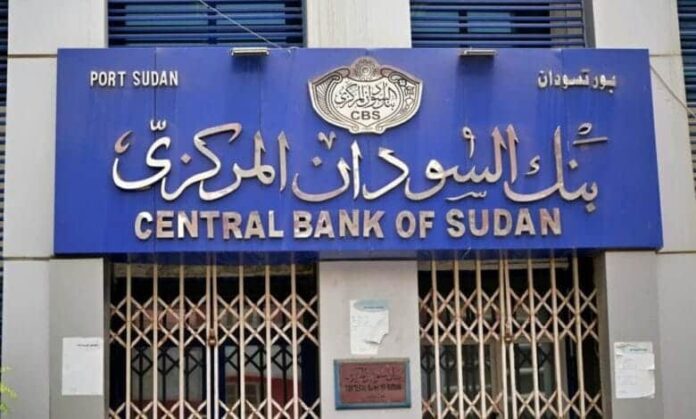
Port Sudan- (SUNA) – The Central Bank of Sudan (CBOS) has issued its monetary and financial policies for 2026, affirming that this year’s policies are centered on reforming and restructuring the banking system, modernizing payment system infrastructure, and strengthening financial inclusion and digital transformation as core pillars for rebuilding confidence and achieving sustainable growth.
According to the CBOS’s circular, the 2026 policies focus on directing financing toward productive sectors and priority activities, contributing to the reduction of inflation and enhancing the flexibility and stability of the exchange rate in support of restoring macroeconomic balance. The policies also adopt the principles of sustainable finance and green finance in line with global trends, alongside improving the management of the national currency.
The Bank of Sudan stated that these policies aim to rebuild a more resilient financial and banking environment, improve banking efficiency, and strengthen the soundness of the banking and financial sector, enabling the national economy to overcome the shocks of the current phase and gradually move toward recovery, stability, and sustainable growth in accordance with governance and risk management standards.
Policy References
The Bank of Sudan’s 2026 policies are based on several key references, including:
The Bank of Sudan Act of 2002, as amended in 2012.
The Banking Business Regulation Act of 2004.
The evaluation of the Bank of Sudan’s policies for 2025.
Guidelines and indicators of the State General Budget for 2026.
The Monetary Cooperation Programme for African central banks and COMESA countries.
Requirements for liberalizing trade in services within the African Continental Free Trade Area, COMESA, and the Greater Arab Free Trade Area.
The United Nations Sustainable Development Goals (2015–2030).
The Maya Declaration issued by the Alliance for Financial Inclusion (2011).
The Bank of Sudan’s Strategic Plan (2026–2030).
The State’s Digital Transformation Plan (3×3), issued in September 2025.
The Transitional Government of Hope Programme.
Key Priorities for 2026
The policies target several priorities, including reforming the banking system and ensuring its continuity, strengthening payment systems through effective liquidity management, and updating and applying liquidity requirements to ensure fulfillment of short-term obligations, while aligning these requirements with the efficiency of payment and settlement systems.
They also include enhancing transparency and disclosure of banks’ liquidity levels, conducting liquidity stress tests, developing an early warning system for real-time monitoring of cash flows, protecting the banking sector from sudden liquidity shocks and reducing the risk of disruption to financial intermediation, and establishing a permanent framework for emergency and liquidity management.
Supervisory and Prudential Policies
The CBOS affirmed that its new policies include applying the Bank of Sudan’s regulations related to international supervisory standards issued by the Basel Committee on Banking Supervision and the Islamic Financial Services Board (IFSB), continuing the adoption of macroprudential policies and risk-based supervision, and conducting an Asset Quality Review (AQR) to assess banks’ conditions and classify them according to their viability.
Banking Sector Reform and Restructuring
In the area of reforming and restructuring banks and non-bank financial institutions, the policies stress the preparation of a comprehensive strategy to reform and develop banks and non-bank financial institutions under the supervision of the Bank of Sudan, defining frameworks, objectives, and key pillars, while ensuring flexibility in response to changes in the banking environment and using the strategy as a tool for engagement with regional and international institutions.
The policies also call for improving the financial positions of banks and non-bank financial institutions by increasing capital, meeting financial soundness indicators, and strengthening governance. They further provide for classifying banks and non-bank financial institutions into four categories:
Category One: sustainable institutions requiring no direct intervention;
Category Two: institutions requiring corrective measures;
Category Three: institutions requiring restructuring;
Category Four: institutions subject to liquidation,
with restructuring options including mergers, acquisitions, or liquidation.
Exceptional Context
In the introduction to its 2026 policies, the Bank of Sudan explained that these policies are being issued under exceptional circumstances resulting from the repercussions of the April 15, 2023 war, which had profound effects on macroeconomic stability and the efficiency of the banking system and its ability to perform its role in financial intermediation. The bank stressed that, in light of these challenges, the pivotal role of monetary and financing policies is to strengthen the supply side, flexibly reallocate resources, and prioritize actions in line with the requirements of economic recovery.

