

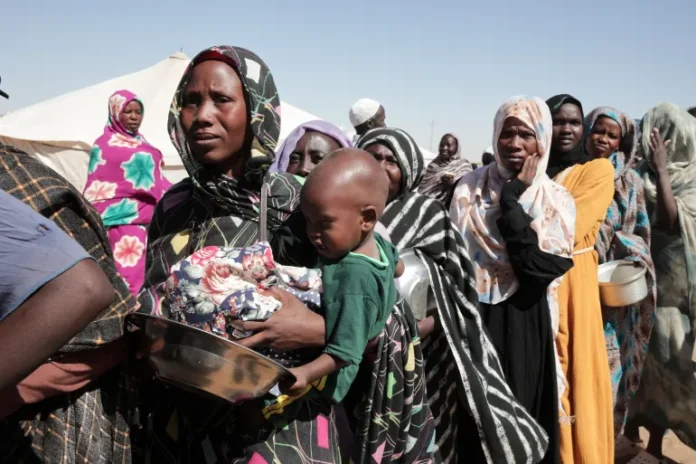
Fierce fighting and global funding cuts have pushed more than 33 million people towards starvation.
Millions of people in Sudan are in urgent need of humanitarian help, aid organisations have warned, as the war in the east African state marked its 1,000th day.
Fierce fighting and global funding cuts have pushed more than 33 million people towards starvation in what has become one of the world’s most severe humanitarian crises, nongovernmental organisations said on Friday as the grim anniversary passed.
Warning that Sudan’s hunger crisis is reaching unprecedented levels, the groups called on global governments to raise efforts to end the war between the country’s military rulers and paramilitary Rapid Support Forces (RSF), which began in April 2023.
Both sides have been accused of war crimes and crimes against humanity, while the RSF has been implicated in atrocities in Darfur that the United Nations says may amount to genocide.
The paramilitary group’s recent resurgence in the vast states of Darfur and Kordofan has forced the displacement of millions more people.
A new UN assessment in North Darfur shows more than half of young children are malnourished – one of the highest rates ever recorded worldwide, said Islamic Relief in a statement.
“More than 45% of people across Sudan – over 21 million people – are suffering acute food shortages and a recent Islamic Relief assessment in Gedaref and Darfur found 83% of families don’t have enough food,” the statement reads.
Separately, a coalition of 13 aid agencies called on the British government, as the UN Security Council penholder, to push for increased funding for the humanitarian response and to drive action to end the fighting.
In a statement, they warned that the world’s largest food crisis has left more than 21 million people facing acute food shortages, noting that millions of displaced people have been forced into unsafe, overcrowded settlements, rife with hunger and disease outbreaks, and gender-based violence.
“The conflict has driven the collapse of livelihoods and services, with an estimated 70 to 80 percent of hospitals and health facilities affected and non-operational, leaving roughly 65 percent of the population without access to healthcare,” the statement said.
“This war cannot be allowed to go on any longer. For 1,000 days we’ve seen our country ripped apart and civilians attacked, starved and forced from their land,” said Elsadig Elnour, Islamic Relief’s senior programme manager in Sudan.
Brutal choices
Yet with the Trump administration in the United States having led huge cuts in humanitarian funding, aid for Sudan is forced to compete with other conflict-plagued locations such as Gaza, Ukraine and Myanmar for an ever smaller pot.
The UN said last month, as it launched its 2026 appeal for aid funding, that it faced “brutal choices”. Due to a plunge in donor funding, it said it was being forced to ask for just $23bn, about half the amount it needs, despite humanitarian needs globally being at an all-time high.
“Sharp cuts in foreign assistance have further weakened humanitarian operations, stripping funding from essential programmes, meaning people won’t have enough to eat and feed their families, have access to basic healthcare, clean water and sanitation, or a safe place to live, with a heightened risk of gender-based violence,” the statement issued by the 13 aid agencies warns.
“Sudan cannot be allowed to fade into another forgotten crisis, worse, a neglected one. The scale of suffering is immense, and we have witnessed the exhaustion and fear etched into the faces of people arriving in search of food, shelter and safety,” said Samy Guissabi, country director for Action Against Hunger in Sudan.
Source: Aljazeera + Agencies’

