

“We cannot erase the atrocities of the past thousand days, but we can shape what comes next.” — The Duchess of Edinburgh
Sophie, Duchess of Edinburgh, has drawn attention to the tragedy of the war in Sudan as it reaches its thousandth day, in a rare article published by The Telegraph under the title “The World Is Ignoring the War in Sudan.” She stressed that the conflict, which erupted in April 2023, has become the world’s most severe humanitarian crisis amid minimal international attention.
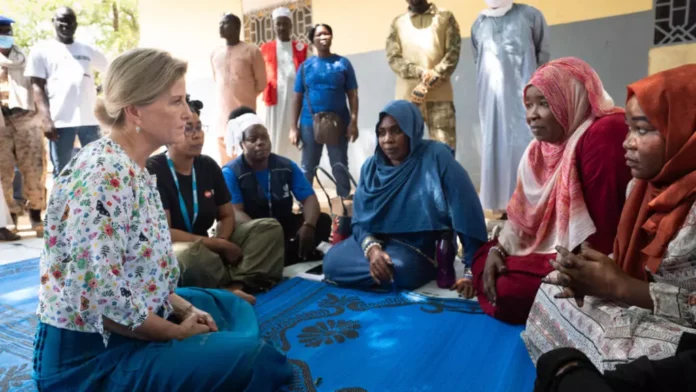
The Duchess recalled her visit in October 2024 to Adré, a Chadian town on the border with Sudan, where she met refugees fleeing the violence. She conveyed harrowing testimonies of families lost entirely and of women exploited sexually in exchange for food and water — all within a war that has claimed more than 150,000 lives and displaced around 13.6 million people, including millions who have fled to neighboring countries.
Despite the gravity of the situation, Sophie said what gave her hope was the “extraordinary strength” she witnessed among refugee women, who play a crucial role in caring for children and rebuilding communities.
As the UN’s advocate for the Women, Peace and Security agenda, the Duchess called for intensified international efforts to end the conflict, emphasizing that the thousand-day mark should serve as a turning point for protecting civilians and supporting the peace process in Sudan. Below is the text of the article and the personal account written by the Duchess of Edinburgh, a member of the British royal family and wife of Prince Edward, the Duke of Edinburgh and younger brother of King Charles III.
A year ago, as I stood on the border with Sudan, I watched an unending stream of people walking or riding donkey carts toward neighboring Chad. Some traveled with their families, others alone. In the stillness of that moment, I felt a deep shiver as I tried to imagine what these weary, traumatized people had experienced and witnessed after fleeing their towns and the brutality of warring militias.
But these were the fortunate ones — those who had managed to reach some measure of safety in Adré, a border town in Chad where local residents, supported by national and international organizations, provided food, water, and shelter. The population of Adré has swelled from forty thousand to over two hundred thousand as Sudanese civilians escape the violence.
During my visit to the transit camp in Adré, I heard stories of profound loss and remarkable resilience: young children whose families had been killed in unspeakable ways; mothers who witnessed the deaths of their husbands and sons; women forced into sexual exploitation simply to access food and water. Their personal accounts, heartbreaking in depth, reflected the experiences of countless others. Their eyes told stories of atrocities no human should ever see — “bodies piled like walls, families drowned at gunpoint, children torn apart, and women raped and beaten. Those who escaped live in constant fear of being killed later.”
As the world enters a new year, we face the grim milestone of 1,000 days of conflict in Sudan. During this time, the crisis has evolved into the world’s most acute humanitarian disaster. It is a moment that demands pause and reflection — not only because of the immense suffering but also because this catastrophe has unfolded under an alarmingly low level of global attention.
Emergency relief alone cannot address the scale of this catastrophe. Humanitarian agencies are exhausted. Local groups, aid organizations, and women-led Sudanese communities continue to do what they can amid overwhelming numbers of people who have lost loved ones, homes, and livelihoods — people who need support now and will need it for years to come.
Girls whose education has been interrupted must be given the chance to return to school. Women, men, and children who have suffered unimaginable sexual violence need access to medical care, safe spaces, and psychosocial support to help them recover and regain their dignity. These are not luxuries — they are basic human necessities.
And yet, even in these desperate conditions, what has stayed most vividly in my mind is the extraordinary strength I witnessed. In one of the mobile protection units operated by Plan International, I met women who had fled the fighting and were now caring for children separated from their families. Their quiet resilience and leadership reminded me once again that women are not only central to survival during crises but also to rebuilding and striving for lasting peace. When supported and empowered, entire communities become more capable of recovery.
As an advocate for the Women, Peace and Security agenda, both at home and abroad, I have seen the compassion and dedication of the international community. But we urgently need more help to end this devastating conflict — to save lives and allow Sudanese families to rebuild their futures in safety.
We cannot change the past thousand days, but this painful milestone reminds us of the opportunity before us — the chance to support those tireless organizations working on the ground and to help shape what comes next. By standing alongside these extraordinary individuals — peacebuilders and women-led organizations among them — we can ensure that the voices and needs of those affected by conflict are heard and valued. Their courage is a powerful reminder that even in the darkest of times, hope endures.
The people of Sudan deserve our compassion, attention, and solidarity — and above all, they deserve to know that the world has not forgotten them, and that the pursuit of peace remains possible.
Monte Carlo International

