

The Sudanese Doctors’ Union reported that the death toll from the Rapid Support Forces (RSF) strike on the market in the city of Dalang, South Kordofan, last Thursday has risen to seven, as the city of El-Obeid, the capital of North Kordofan, faces the threat of another siege.
According to the independent medical network, the dead include three children and two women, while 32 others were injured, most of them children and women.
The organization condemned “in the strongest possible terms this massacre, which constitutes a grave violation of international humanitarian law and a systematic crime against unarmed civilians.”
It stressed that “targeting residential neighborhoods, markets, and civilian gatherings represents a dangerous escalation that worsens the suffering of citizens and undermines all efforts to protect civilians.”
The Doctors’ Union held the RSF leadership fully responsible for the attacks and the resulting civilian casualties, saying the group had deliberately targeted civilian infrastructure.
Local media outlets earlier reported that five people were killed and 25 were injured in a drone strike carried out by RSF aircraft on a market in Dalang on Thursday.
That same day, the UN Office for the Coordination of Humanitarian Affairs (OCHA) in Sudan expressed its concern over reports of a drone airstrike targeting a crowded market in Dalang, South Kordofan.
The cities of Kadugli and Dalang, both in South Kordofan State, have been under RSF siege for more than two years, enduring repeated shelling and drone attacks since the early months of the war.
The Return of the Siege in El-Obeid
Meanwhile, the city of El-Obeid, the capital of North Kordofan in central Sudan, is again facing the risk of encirclement by the Rapid Support Forces.
According to Agence France-Presse (AFP), citing the Yale University Humanitarian Research Lab, El-Obeid “faces the threat of a new siege,” with recent satellite imagery revealing “a new belt or earthen barriers along the main exit routes from the city.”
Miji Park, acting country director for Mercy Corps in Sudan, said that “the most vulnerable populations who cannot travel on foot are essentially trapped inside the city.”
Park added in a statement to AFP: “We have heard testimonies from men who were turned back while attempting to leave the city,” expressing concern that El-Obeid “may become the next epicenter of the conflict.”
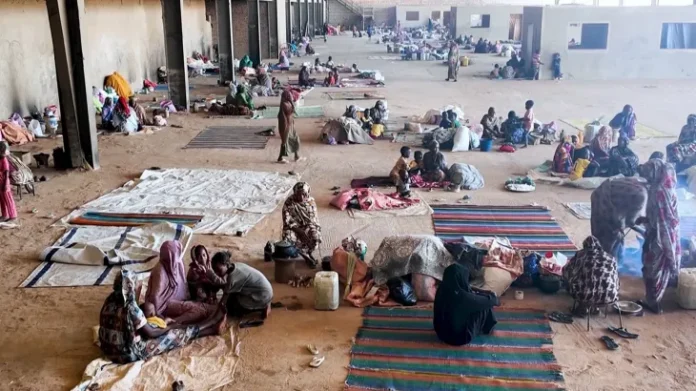
The city currently hosts tens of thousands of displaced people, according to the UN High Commissioner for Refugees (UNHCR), and also contains an airport long used for military logistical operations.
Since the start of the war, more than 220,000 people have fled North Kordofan, according to data from the International Organization for Migration (IOM).
Source: Anadolu Agency

