
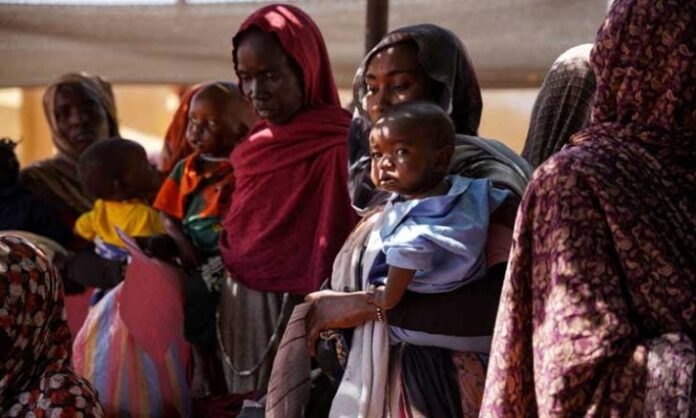

All Maryam (a pseudonym) wanted was to escape the deadly shelling of war by fleeing from the Abu Qurun Market area in El Fasher, the capital of North Darfur State in western Sudan, to the Al-Dabba camp in the Northern State.
But the journey of displacement began with the amputation of a leg and witnessed acts of humiliation, torture, and rape committed before the eyes of children — atrocities perpetrated by the Rapid Support Forces (RSF), which have been fighting the army since April 2023.
Maryam recounts the painful details of her displacement, saying: “I left the city (El Fasher) with my brother, who had been injured by a shell in the Abu Qurun Market, leading to the amputation of one of his legs.”
She continues: “We decided to leave after his condition worsened in the hospital due to lack of food and treatment for a long time.”
“We first reached the village of Hilla Sheikh (in the outskirts of El Fasher) with great difficulty, walking on foot my brother on one leg, along with my children, my brother’s wife, and his children,” she adds.
Maryam continues: “We couldn’t find any vehicle to transport us to the village of Qurna (also near El Fasher). After three hours of walking, we met a man with a donkey.”
“We asked him for help to carry my brother on the donkey. He agreed to take us only as far as the outskirts of Qurna because the RSF prohibits anyone from transporting people,” she recounts.
Interrogation and Suffering
“After six hours of walking, as we approached an RSF checkpoint, we took my brother off the donkey and walked on foot toward the entrance to Qurna. We arrived exhausted and out of water,” Maryam says.
Pausing to take a deep breath, she continues: “In Qurna, RSF members interrogated us, focusing on my brother, accusing him of being an army soldier.”
She adds: “I intervened and told them we were civilians. I was also injured by shrapnel, like my brother, and showed them my wound. My brother’s condition deteriorated and he fainted, so they gave him intravenous fluids.”
“Once his condition stabilized, they put us on tractors along with others. We didn’t know where we were being taken. After a while the tractors stopped, and some passengers got off. That’s when I learned we had reached the area of Kurma (outside El Fasher),” Maryam explains.
All Stripped Naked
“I asked where we were going, and they said to the city of Kabkabiya in North Darfur. The tractors kept moving for a while,” she says.
“Then the tractors stopped after being blocked by seven RSF military vehicles. Everyone was ordered to get off.”
“They lined us up men and women and ordered us to remove our clothes. Anyone who refused was beaten with rifle butts and forced to strip.”
With sadness and shame, Maryam adds: “That’s how we all ended up naked. The men were ordered not to bow their heads but to keep them up,” meaning they were forced to look at the others.
“They began beating my injured brother harshly. I couldn’t bear it, so I ran toward him and took some of the blows in his place. They even beat his amputated leg until it bled,” she says in anguish.
“All this happened in front of the children as they watched their relatives naked.”
Killing and Rape
“The soldiers ordered four girls in good health among the tractor passengers to step out and get into one of their vehicles, covering themselves with a single thobe (traditional Sudanese garment),” Maryam recounts.
“One of the girls was with her mother and brother, who tried to talk to the soldiers, but they shot him six times and he died instantly.”
“His mother, unable to bear the sight, began screaming and crying, shouting ‘My son… my daughters!’ They struck her on the head with a rifle butt, and she fell bleeding,” Maryam says, tears breaking in her voice.
“One of the soldiers approached me, grabbed my hand, and dragged me some distance away from the others,” she continues.
“He took me behind a tree and tried to assault me. I resisted, so he kicked me, and I fell to the ground. My arm was dislocated and my head spun. Then he raped me.”
“When I regained consciousness, I saw one of the other women who had been with us on the tractor being assaulted by two soldiers while her 13-year-old son tried to intervene. They beat him until he fell, then continued raping her,” Maryam recounts.
“From where I lay, I saw other RSF vehicles arrive and question the group that had stopped and attacked us, asking, ‘What do you want with these people?’ They then ordered them to let us go.”
“Indeed, we were allowed to get back on the tractor — but without the four girls, who had been taken away,” she says.
Distortion of Truth
“We arrived in Kabkabiya (about 150 km from El Fasher) and started looking for a vehicle to take us further. The tractor driver gave me some money to reach the hospital, helping me and my injured brother,” Maryam says.
“At the hospital, they told us to file a report, so we went to do so.”
“But when we said that RSF soldiers assaulted us, the official in charge became angry and said, ‘None of the RSF would attack a citizen. We work for the people,’” she recalls.
“He asked us to change our statement, claiming that it was army soldiers and rebel movements who attacked us and that’s what I had to say.”
“They decided my brother needed surgery. While in the hospital, I began coughing and fainted. When examined and X-rayed, they found bleeding and fluid on one side of my abdomen,” Maryam says.
“They decided to operate, but I told the doctor I couldn’t undergo surgery because I was accompanying my brother and had children with me. If I had the operation, who would look after them?”
“The doctor gave me painkillers and medicine, which I’m still using until I can have the surgery later,” she adds.
“We stayed in the hospital for 12 days, then left Kabkabiya for Umm Badr in North Kordofan after one of the hospital guards gave me money to travel and helped me a great deal.”
“From there, we reached the camp in Al-Dabba after a five-day journey,” Maryam concludes, saying she will never forget this ordeal.
RSF forces often deny committing crimes against civilians, describing such incidents as isolated cases.
Evidence of Rape
Extensive local and international documentation exists of rape crimes committed by the RSF.
On December 7, 2025, the Sudanese Doctors’ Network (a civil organization) reported documenting the rape of 19 Sudanese women while fleeing from El Fasher to Al-Dabba.
Earlier, on November 16, 2025, it said it had documented 32 rape cases of girls from El Fasher displaced to the Tawila camp in North Darfur since RSF forces overran the area on October 26, 2025.
On November 11, the United Nations Entity for Gender Equality and the Empowerment of Women (UN Women) condemned in a statement the RSF’s crimes, stressing that rape was being used “deliberately and systematically.”
On November 3, the International Criminal Court announced that it was collecting evidence of mass killings and sexual violence following the RSF takeover of El Fasher.
On October 26, RSF captured El Fasher and committed massacres against civilians, according to local and international organizations, warning of the growing risk of Sudan’s geographic fragmentation.
Amid these atrocities, RSF leader Mohamed Hamdan Dagalo “Hemedti” acknowledged on October 29 that what occurred in El Fasher were merely “violations,” claiming that investigative committees had been formed.
RSF currently controls all five Darfur state capitals in western Sudan out of the country’s 18 states, while the army holds most of the remaining 13 in the south, north, east, and central regions, including the capital, Khartoum.
The Darfur region makes up about one-fifth of Sudan’s territory — over 1.8 million square kilometers — though the majority of the 50 million Sudanese population lives in areas under army control.
The RSF’s war against the army, rooted in disputes over unifying the military institution, has caused famine in what has become one of the world’s worst humanitarian crises, killing tens of thousands of Sudanese and displacing nearly 13 million people.
(Source: Anadolu Agency)