


Analysis by Al-Yurae Opinion
Sudan’s army chief, Abdel Fattah al-Burhan, has once again stirred political debate with his proposal to expand the current mediation track by adding Turkey and Qatar to the like of the peace initiatives driven by the U.S., Saudi Arabia, Egypt, and the UAE.
On the surface, the suggestion seems diplomatic. In reality, it bears the markings of a calculated political maneuver aimed at reshaping the negotiation framework and perhaps reopening the door for Islamist influence inside the Sudanese military establishment.
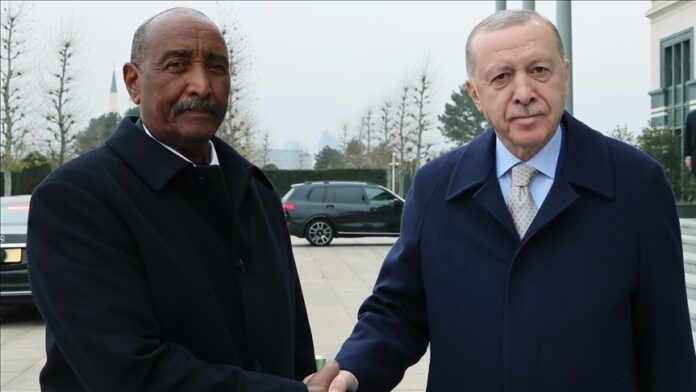
Speaking from his residence in Port Sudan to Turkish journalists, including Anadolu Agency, Burhan praised the “steadfastness” of his government during the war, crediting support from “friendly nations, foremost among them Turkey and Qatar.” He reaffirmed trust in President Recep Tayyip Erdoğan and insisted that the army intends to “defeat the Rapid Support Forces (RSF)” before any lasting peace can take hold.
The Quad and Its Red Lines
The Quad Initiative, formalized in 2025, seeks to coordinate international mediation to end Sudan’s devastating war. Its roadmap consists of three stages a humanitarian truce, a long-term ceasefire, and a civilian-led political transition anchored in five principles, including the exclusion of extremist Islamist groups linked to the Muslim Brotherhood and a ban on all external military support to warring factions.
For Sudan’s Islamist network, known locally as “the Kizan,” these terms represent an existential threat. The Brotherhood’s political legacy is tied to the three-decade rule of Omar al-Bashir, toppled in 2019. Thus, the Quad’s conditions, especially those rejecting military-Islamist entanglement, have been met with fierce opposition among conservative elites within the army.
While civilian coalitions such as Samood (led by ex-PM Abdalla Hamdok) have endorsed the Quad plan as “the most realistic path toward peace,” Burhan’s responses have been contradictory and tactical at times signaling openness, then retracting, then claiming that “no foreign agenda will be accepted.”
Analysts see this as part of the military’s balancing act between maintaining international legitimacy and preserving domestic power structures dominated by Islamist loyalists.
A Shifting Network of Alliances
Burhan’s recent diplomatic overtures reveal a pattern of strategic reorientation eastward. In mid‑2024, Sudan restored relations with Iran after an eight‑year freeze, a decision that unsettled neighbors and Western partners alike. At the same time, his deputy Malik Agar courted Moscow, while Western intelligence reports pointed to Iranian-made Mohajer‑6 drones at Sudanese army bases north of Omdurman.
These moves suggest not ideological conviction but pragmatic survivalism, signaling to the Quad that Burhan still has alternative alliances if its pressure intensifies.
Yet Washington’s response was swift: pursuing deeper collaboration with Moscow or Tehran, officials warned, “will further isolate the Sudanese military regime and risk widening the conflict.”
The Islamist Undercurrent
Despite Burhan’s repeated denials of links to the Muslim Brotherhood, evidence of Islamist infiltration within the army remains overwhelming. Videos surfaced showing commanders from the Islamist “Al‑Baraa Brigade” boasting that they have fought alongside the army since 2011. Former officials such as Ahmed Abbas, ex-governor of Sennar, claimed publicly that “75% of Burhan’s fighters” are members of the Islamic Movement.
Observers argue that Sudan’s armed forces were never fully cleansed of the Brotherhood’s influence after Bashir’s fall. The 2019 revolution dismantled the regime’s top layer but left its security and economic networks intact. The 2021 coup, jointly staged by Burhan and his then‑ally turned rival Mohamed Hamdan Dagalo (Hemeti), reopened the gate for these networks laying the groundwork for today’s war.
Thus, Burhan’s drive to involve Turkey in the peace mediation cannot be viewed as neutral diplomacy. It’s a clear attempt to reinsert Islamist‑aligned stakeholders into the peace equation under an acceptable international umbrella.
Burhan’s Gamble
For all its diplomatic polish, Burhan’s proposal carries heavy political baggage. By suggesting Turkey and Qatar two historical allies of Sudan’s Islamists join the mediation, he is testing international tolerance while trying to shield loyalist circles within the army.
As “Al‑Yurae” sees it, this is a tactical diversion designed to weaken the Quad’s conditions and legitimize actors the initiative explicitly seeks to exclude.
The fundamental question, however, remains unchanged:
Is the Sudanese military truly fighting to preserve the state or to preserve an ideology that brought the state to collapse?
In either case, Burhan’s move risks further politicizing an already fragmented conflict and undermining the prospects for a civilian‑led, inclusive peace that Sudan’s weary population has long awaited.