

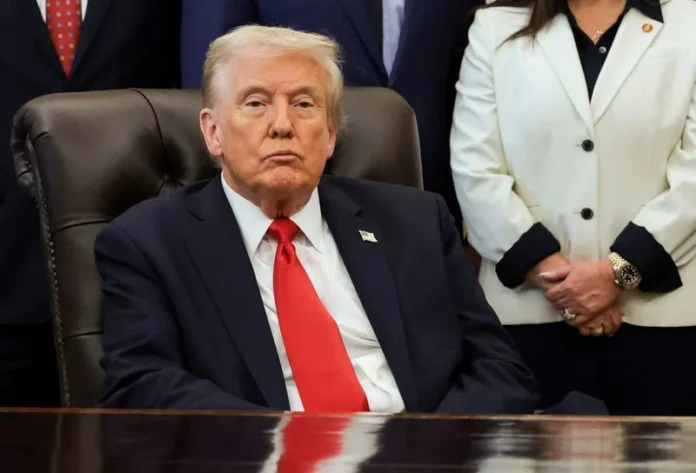
President Trump’s announcement earlier this month that he will push for a ceasefire in Sudan has been welcomed by officials and experts as shining a light on a devastating conflict that has fueled the world’s worst humanitarian crisis.
But experts are cynical that a breakthrough will materialize, citing the administration’s shallow diplomacy, Trump’s conflict of interests with the war’s international backers and the president’s seeming unwillingness to exert meaningful pressure.
“During the last year, we used to call Sudan ‘the forgotten war’ and we are,” said Areig Elhag, Arabic Content Editor at the Washington Institute for Near East Policy and previously a journalist with the formerly U.S.-funded Middle East Broadcasting Network.
“I think [Trump’s] attention has given the sudden and strong push, and I’m very optimistic about that, but at the same time, we shouldn’t forget that Sudan, unfortunately, has never been a priority for U.S. administrations.”
During his first term, Trump removed Sudan from the list of State Sponsors of Terrorism after a grassroots revolution overthrew the 30-year dictatorship of Omar al-Bashir. But the transition to a civilian-led democracy fell apart in April 2023, with the outbreak of war between the national military, the Sudanese Armed Forces, and the paramilitary group Rapid Support Forces.
After two years of war, Sudan is described as a nightmare of violence, disease and starvation. More than 150,000 people have died in the conflict, some 14 million have been displaced and about half the population of 50 million people is expected to go hungry this year.
The U.S. determined RSF General Mohamed Hamdan Dagalo, known as “Hemeditti,” has carried out genocide. Sudan’s interim president and leader of the SAF, General Abdel Fattah al-Burhan, is also accused of overseeing grievous violence against civilians. Famine was declared in some areas beginning in 2024.
Trump announced on Nov. 19, following a meeting with Saudi Arabia’s Crown Prince Mohammed bin Salman, that he would use his influence to push for a ceasefire between the SAF and RSF.
But the Saudi request signaled Riyadh saw the SAF, which it backs as the legitimate military force, struggling in the face of the United Arab Emirates-backed RSF. Abu Dhabi denies that it provides weapons to the RSF, although a United Nations panel said allegations are credible and a pair of Democratic lawmakers said U.S. intelligence pointed to UAE military backing.
Trump as ‘referee’ between Gulf countries
Both Saudi Arabia and UAE view Sudan as a strategic location to exercise influence in the Red Sea and project power into Africa. Analysts criticize the two outside players as exacerbating the war.
“A lot of the conversations that are happening right now between Washington and Riyadh and Washington and Abu Dhabi aren’t actually about Sudan, but are about these middle powers that have risen in terms of their ability to project force, to project influence, to project power, and their competition with each other,” said Kholood Adair, director of Confluence Advisory, formerly a Khartoum-based policy and advocacy organization focused on peace and security.
“Those interests are becoming more and more at odds, in particular on the Red Sea Basin, and therefore the Horn of Africa, and they’re relying more and more on President Trump or the Americans in general to act as a referee between them.”
While Secretary of State Marco Rubio said earlier this month that weapons need to be cut off to the RSF, he did not call out the UAE.
The Trump administration has worked through the so-called Quad grouping — made up of Egypt, Saudi Arabia and UAE — to reach consensus among the war’s enablers and then, theoretically, impose pressure on the SAF and RSF.
The Quad, in a September communique, called for a three-month humanitarian truce and agreed on a joint set of principles surrounding the war, in particular that external military support must stop and Sudan’s future belongs to the Sudanese people, not warring factions.
But the document did little to lay out a roadmap to achieve those stated values, said Cameron Hudson, former Africa Director at the National Security Council and who served as chief of staff to multiple special envoys for Sudan.
“There are no consequences… We’ve called on you to stop, but if you don’t stop, there’s no consequence to not stopping, that’s number one,” he said.
“Number two, we haven’t taken away their ability to keep fighting… if we were really trying to put pressure on them, then we would be imposing an arms embargo.”
And Trump is seen as unlikely to exercise tough leverage on either Saudi Arabia or the UAE. Both countries have promised major investments in the U.S. as part of Trump’s “America First” mantra for his second term, but his family’s business is also intimately linked to both countries.
The Saudi Public Investment Fund is a major investor in Jared Kushner’s private equity firm. And a $1 billion Trump hotel is planned to be build in the Saudi city of Jeddah. The UAE is described as a “hub” for the Trump family’s international business ventures.
‘They don’t see a reason to stop’
Absent meaningful pressure from the international community on both parties, analysts say there’s no incentive for Burhan and Dagalo to come to a truce.
A U.S. attempt at a ceasefire earlier this month was dismissed by Burhan on Monday as “the worst document yet,” criticizing it as weakening the Armed Forces and preserving the RSF, which said it agreed to the terms.
Massad Bolous, father-in-law to Trump’s daughter and the president’s senior advisor for African Affairs, said on Tuesday that neither side agreed to the truce.
Sudan’s dry season provides peak fighting conditions, and Dagalo has gained a major strategic foothold with the takeover last month of the Sudanese city of El Fasher, said Adair.
The fall of El Fasher shocked the international community, with blood-soaked ground from the mass killings visible from space, and the few survivors recounting harrowing stories of witnessing executions and suffering sexual violence.
The RSF is reportedly redeploying from El Fasher and moving eastward, with the goal of taking Khartoum and moving toward the Red Sea coastline, Adair said.
“They don’t see a reason to stop, because they have the momentum now,” she said.
Shallow diplomacy so far
Trump has yet to appoint a federally required special envoy for Sudan, while the administration’s destruction of the U.S. Agency for International Development, reduction of State Department staff, elimination of key offices dealing with democracy, human rights, refugees and others have wiped out a key base of institutional knowledge on the region.
And Trump’s reliance on Bolous to address Sudan — even if viewed as a well-meaning envoy — underscores what analysts see as an understaffed effort.
“I’ve been involved in efforts when the president indicates a shift in policy and two things happen: We write a policy, but also there’s typically, some kind of personnel move,” Hudson said.
“You either designate someone high-level to be in charge of that policy, you put together a team, you create an office, you do something bureaucratically, to say, ‘Okay, we’re dedicating human resources to this, and we’re developing a strategy.’ Neither of those things have happened.”
Adair said the Quad is a flawed grouping for trying to achieve a ceasefire and is also unlikely to put civilian rule forward.
“It is a formation of countries that are all — with the exception of the United States — deeply involved militarily and financially in Sudan and therefore have an interest,” she said.
“The Saudis, Egyptians and Emiratis have never wanted civilian democratic rule in Sudan. The United States says that it does, how do you square that circle?”
Elhag said that Trump’s decision this week to designate the Muslim Brotherhood a terrorist organization is a good signal of pressuring some of the networks that support the SAF, which could help push towards a ceasefire. She called for greater enforcement of the 2005-era arms embargo to the Darfur region and additional sanctions on Dagalo’s inner circle.
But she warned of a long and arduous path.
“The solution of helping Sudan, we need to rebuild it from scratch… you need to rebuild the people, and the trust between the Sudanese themselves,” she said.
Copyright 2025 Nexstar Media, Inc. All rights reserved. This material may not be published, broadcast, rewritten, or redistributed.
Source: The Hill.

