

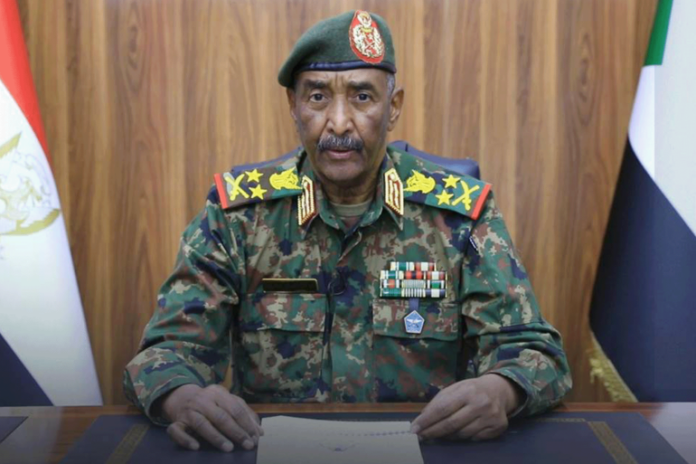
The head of Sudan’s Transitional Sovereignty Council, Abdel Fattah Al-Burhan, said on Saturday that Khartoum will not accept a truce or a ceasefire as long as the Rapid Support Forces remain in a single inch of Sudan.
Burhan stressed, during a meeting with Sudanese and Turkish figures at the Sudanese embassy building in Ankara, that the Sudanese Armed Forces are relying on themselves to decisively end the rebellion, while seeking to involve Turkey and Saudi Arabia in persuading Washington to engage with the Sudanese peace initiative, noting that the level of cooperation between Khartoum and Ankara is unprecedented.
He emphasized that the army trusts only Sudanese-Sudanese dialogue, and that the fighting will continue until the Rapid Support Forces lay down their arms, and he affirmed that Khartoum had previously accepted the conditions put forward in the Jeddah negotiations, but the RSF chose to continue the war.
He also indicated his optimism about the initiative launched by Saudi Crown Prince Mohammed bin Salman in coordination with U.S. President Donald Trump, expressing hope that it will help advance the peace process in line with the Sudanese government’s vision.
Burhan confirmed that the roadmap recently presented by Prime Minister Kamal Idris to the United Nations is the initiative of the Sudanese state that has been agreed upon, and that it constitutes a basis for addressing the crisis.
Idris had presented, last Monday, before the Security Council, a settlement plan aimed at a comprehensive ceasefire and the disarmament of the Rapid Support Forces.
The initiative provides for a comprehensive ceasefire under regional and international sponsorship, the withdrawal of the Rapid Support Forces from the areas under their control and the assembly of their fighters, in addition to launching a Sudanese dialogue based on reconciliation and the reintegration of fighters into society.
RSF Rejection
The Rapid Support Forces announced on Tuesday their rejection of the initiative to end the war that Khartoum had submitted to the United Nations Security Council.
Basha TiBiq, adviser to the commander of the Rapid Support Forces, said that the initiative is nothing but a recycling of a worn-out exclusionary discourse that does not differ in essence from the discourse of the head of the Sudanese Sovereignty Council, Abdel Fattah Al-Burhan.
TiBiq added, in a post on his Facebook account, that Idris does not possess the will or the authority that would qualify him to speak about stopping the war, let alone launch a political initiative of real weight, and he considered that what was stated in the initiative regarding the necessity for the Rapid Support Forces to withdraw from the areas under their control and describing them as a militia is a proposal closer to fantasy than to politics.
The Sudanese prime minister considered on Friday that any truce to stop the war must coincide with the disarmament of the Rapid Support Forces and the assembly of their members in camps.
He explained, at a press conference held in the city of Port Sudan in the east of the country after his return from New York, that Sudan is a sovereign state and that any international monitoring must be by agreement, adding, “We will not accept any UN forces in Sudan; we have been burned before by the presence of such international forces.”
He stressed that the peace initiative he presented before the UN Security Council confirms that they are “advocates of peace, not advocates of war,” affirming that one of the most prominent messages of his visit was to underscore the Sudanese people’s desire for peace, and he added, “This initiative has moved us from the position of recipient to the position of owner of the initiative.”
Sudan has been suffering from an ongoing war since April 2023 between the army and the Rapid Support Forces, which has claimed the lives of tens of thousands of people and led to the displacement of around 13 million others.

