
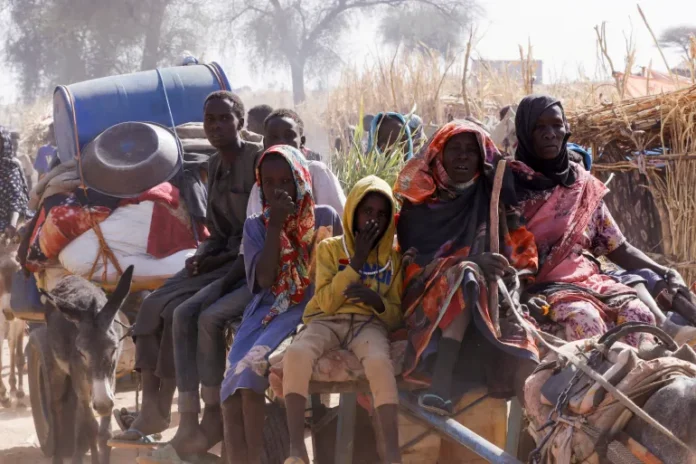
In the outskirts of the city of Kosti, south of Khartoum in White Nile State, where displacement camps stretch like open wounds across geography and memory, the suffering of war intersects with the details of daily life to produce harsh human stories, whose protagonists are women who have taken on doubled roles: saving lives, protecting education, and filling the gap in health care amid scarce resources and the absence of support.
Muna Sharaf Al-Din Muhammad, a community midwife and displaced from the Jabal Al-Dair area for nearly two years, has seen the displacement tents turn into emergency delivery rooms and into arenas for a daily confrontation with danger. She told Al Jazeera Mubasher that she deals with complicated childbirth cases in extremely difficult conditions, where pregnant women lack the most basic requirements for health and material preparedness.
She explains that women’s suffering does not end with obstructed labor; rather, a harsher stage begins when cases are referred to hospitals, as families even in emergencies are required to provide blood and pay surgical fees immediately, in the absence of men or any urgent source of support.
Muna recalls an incident that almost ended in disaster, when she accompanied a woman during her first delivery, and the hospital refused to intervene before blood and fees were secured, until one of the volunteers stepped in at the last moments and saved the situation.
She adds sadly that some women are forced to give birth without anesthesia simply because they cannot afford the treatment costs, in a scene that encapsulates the extent of the cruelty that the war has imposed on mothers.
A school without walls
A few meters away from the makeshift delivery rooms, Somaya Ibrahim Abdullah is fighting a different battle, titled saving education from collapse. Somaya, a primary and middle school teacher, was the principal of a private school in Khartoum before the war forced her into displacement at the “Goz Al-Salam” camp in Kosti.
Inside the camp, Somaya and a number of teachers decided to volunteer to teach displaced children whose educational paths had been cut off, so they set up rudimentary classrooms to try to make up for what they had missed. However, the road was not easy, as the obstacles are many: no proper buildings, no blackboards, no books, and no desks.
Somaya says that a student can barely afford a pen and a single notebook, while teachers lack the most basic teaching aids that would enable them to fulfill their mission. Nevertheless, she insists on continuing, considering that education in these circumstances is not just schooling, but a last line of defense to protect children’s future from being lost.
A nursing student serving the camp
As for Raw’a Amer Mahmoud, displaced from Khartoum and a nursing student at Al-Ribat National University, the war imposed a forced one-year halt on her university journey. Today, Raw’a is trying to complete her exams online, clinging to a dream that the war has not extinguished.
During her stay in Kosti, she received practical training at the teaching hospital and the police hospital, gaining multiple nursing skills, from inserting intravenous lines to administering injections and medications. Due to the distance of the health center from the camp, she decided to put what she learned at the service of her people, providing first aid and nursing care to the displaced as voluntary humanitarian work.
Raw’a says that people come to her at all times, even late at night, seeking medical assistance that may be simple, but for them it is a matter of life or death.
Between a midwife fighting hemorrhage, a teacher resisting ignorance, and a nursing student filling the gap in care, the image of human resilience in the Kosti camps comes into full view. These are stories that do not top political headlines, but they reveal the true face of war, where women become the last lines of defense in the battle for survival, and humanity, despite everything, remains present under the harshest of conditions.
Source: Al Jazeera Mubasher

