
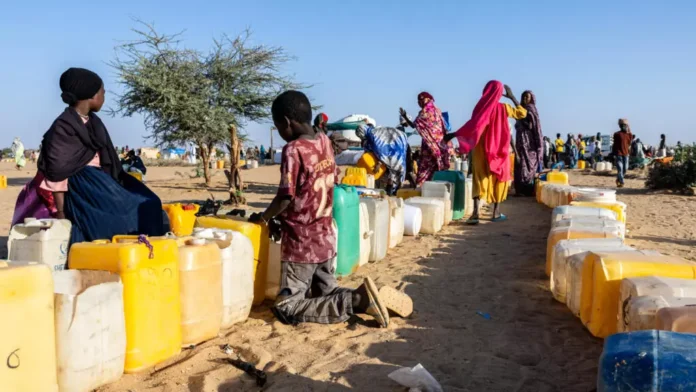
Adré (Chad) (AFP) – The new UN High Commissioner for Refugees, Barham Salih, continued Thursday his tour of camps in eastern Chad that shelter one million Sudanese displaced by the conflict in their country, which he described as “the largest displacement crisis of our time.”
The war that has ravaged Sudan since April 2023 between the army and the Rapid Support Forces has claimed tens of thousands of lives and displaced more than 14 million people, according to figures cited by Salih, who on Thursday visited the Iridimi camp, home to 49,000 Sudanese refugees.
In an interview with Agence France-Presse on Wednesday, Salih who served as president of Iraq from 2018 to 2022 and took office as UN High Commissioner for Refugees in January said that “more than a thousand days of fighting in Sudan have caused immense suffering and resulted in the largest displacement crisis of our time.”
He added, “The world must pay much greater attention to the plight of Sudanese refugees,” emphasizing that “the assistance provided by the UNHCR is far from sufficient.”
Salih also visited the Farchana camp, established in 2004 following a previous conflict in neighboring Darfur (western Sudan), which currently hosts around 65,000 refugees, and then the Adré camp, located on the border with Sudan, which houses 230,000 people.
Hatem Abdallah al-Fadil, a representative of the refugees in Farchana, said, “The same kinds of crimes and human rights violations are still being committed in Sudan, and the international community remains silent.”
Salih praised Chad’s efforts in receiving Sudanese refugees, noting that its borders “have not been closed” despite its “limited resources.”
Chadian Minister of Social Affairs Zara Mahamat Issa told AFP on Thursday that Chad is hosting more than one million Sudanese refugees, stressing that “the needs are enormous, but resources have become extremely scarce.”
She expressed hope that Salih would raise Chad’s voice with donors and the international community, so that the burdens borne by the country would be shared more equitably.

