

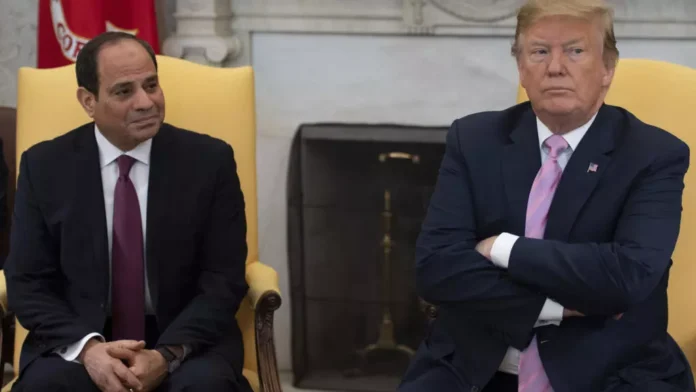
Egyptian President Abdel Fattah El-Sisi and Sudan’s Sovereign Council Chairman Abdel Fattah Al-Burhan on Saturday welcomed U.S. President Donald Trump’s offer to mediate in the dispute over Nile River waters with Ethiopia.
In a post on X, President El-Sisi said he had sent a letter to Trump reaffirming Egypt’s position and concerns regarding its water security, which have arisen due to Ethiopia’s Grand Renaissance Dam project.
El-Sisi added that Egypt reaffirmed its commitment to serious and constructive cooperation with the Nile Basin countries based on international law and shared interests, without harming any party — principles that underpin Egypt’s position on the issue.
For his part, Sudan’s leader Abdel Fattah Al-Burhan announced his government’s welcome and support for President Trump’s offer to mediate the Nile water dispute.
In an X post, Al-Burhan said: “The Government of Sudan welcomes and supports President Trump’s initiative and mediation on the Nile Waters issue to help find sustainable and satisfactory solutions that preserve everyone’s rights, thereby contributing to lasting security and stability in the region.”
On Friday, Trump said he had informed his Egyptian counterpart Abdel Fattah El-Sisi that he was ready to serve as a mediator in the ongoing dispute between Egypt and Ethiopia over the Renaissance Dam.
Trump expressed in a letter to El-Sisi—shared via his Truth Social platform—that he was ready to resume U.S. mediation between Egypt and Ethiopia to reach a “fundamental and lasting resolution” to the Nile water-sharing issue.
“I want to help you reach an outcome that secures the long-term water needs of Egypt, the Republic of Sudan, and Ethiopia,” Trump wrote.
Addis Ababa has accused Cairo of ignoring the needs and rights of other countries and insists that disputes can only be resolved through direct dialogue among the concerned parties. Ethiopia maintains that “water security” must be based on the equitable and reasonable use of the Nile’s waters by all basin nations.
Meanwhile, Egypt and Sudan have long demanded that Ethiopia agree to a binding trilateral legal framework governing the filling and operation of the Grand Ethiopian Renaissance Dam (GERD), construction of which began in 2011.
What Did Trump Propose?
On Friday, President Trump reiterated the United States’ readiness to resume its mediation between Egypt and Ethiopia in order to reach a final, binding agreement on Nile water sharing.
Trump warned that any unilateral control over the Nile’s resources could threaten regional stability.
In his letter—extracts of which were released by the Egyptian presidency—Trump suggested that the United States might use its influence to encourage fair and transparent negotiations under strong international supervision and to secure a binding agreement.
He cautioned that any unilateral domination of the Nile’s resources would endanger regional stability, a tone analysts interpreted as indirect pressure on Ethiopia, though without explicit mention.
Trump also expressed concern that the conflict could expand to include a military confrontation between Egypt and Ethiopia, emphasizing that the Nile’s waters hold strategic importance for both Egypt and Sudan.
He underscored that the “regional tensions” surrounding this issue are a top priority in his efforts to establish lasting peace in the region. Trump stressed that any enduring agreement must guarantee predictable water flows during dry seasons while allowing Ethiopia to benefit from the dam’s hydroelectric capacity.
Cairo has consistently asserted that the Nile water issue is existential and cannot be addressed with temporary solutions. Observers see in the renewed U.S. initiative to resume dialogue a “constructive opportunity” to bring negotiations back on track.
The Renaissance Dam crisis dates back to 2011, when Ethiopia began constructing the dam on the Blue Nile without a binding agreement with Egypt and Sudan—triggering a long series of stalled negotiations under regional and international mediation. Talks officially collapsed at the end of 2023, with Cairo blaming what it called “Ethiopian intransigence” over the matter.
Source:Al-Yurae/ Agencies

