

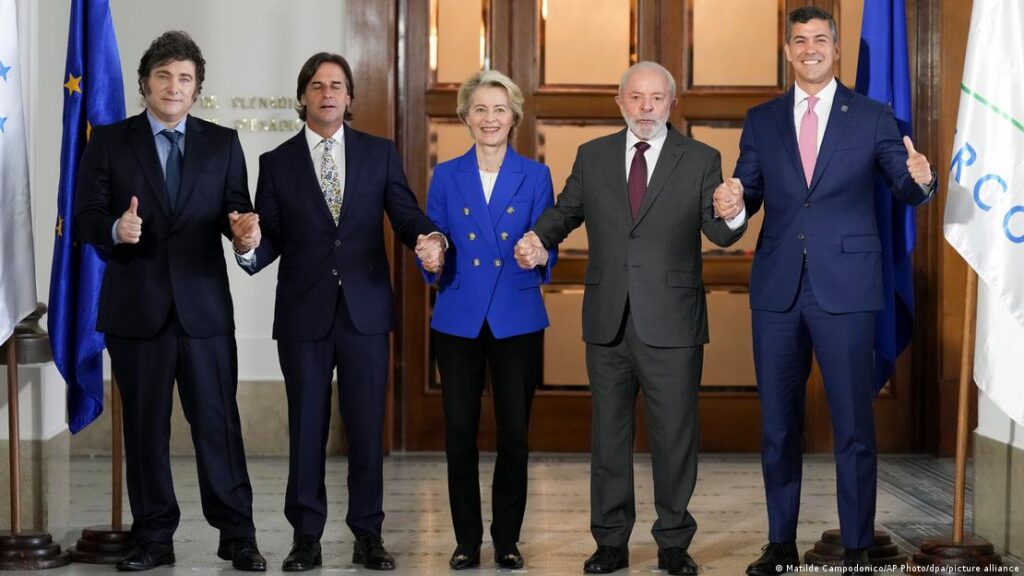
It’s a day more than a quarter of a century in the making: On Saturday, European Commission chief Ursula von der Leyen is jetting off to Paraguay to sign the EU’s biggest-ever trade deal with South America’s Mercosur bloc.
The EU is styling the megadeal as proof it can forge alliances and chart its own course in an age of disorder. But the pact remains unpopular with climate campaigners, farmers and EU heavyweight France — and could still be derailed when EU parliamentarians have their say in a vote later this year.
EU-Mercosur deal: ‘Not just about trade’
The new pact will see the EU’s 27 members join forces with Brazil, Argentina, Paraguay and Uruguay to create one of the world’s biggest free trade zones.
Negotiations started back in 2000, a heyday for globalization when new partners seemed easier to come by for Europe. But with war in Ukraine raging to the east and US tariffs disrupting trade with the West, foreign policy analyst Andres Malamud says the deal now carries a different political weight.
“Twenty-six years ago, this was an agreement about leadership, about setting rules for trade in the world,” he told DW. Now, as the EU’s share in the global economy has dropped over the years, “it’s about resilience.”
Malamud described the deal as an EU attempt to re-assert rules-based order and norms, “which are kind of disappearing in the rest of the globe.” In this sense, he added,”this not just about trade, it’s about political cooperation and political dialogue.”
Increasing EU access to minerals
Though the deal won’t be an economic gamechanger for EU gross domestic product (GDP), it could unlock access to materials seen as crucial for the continent’s future.
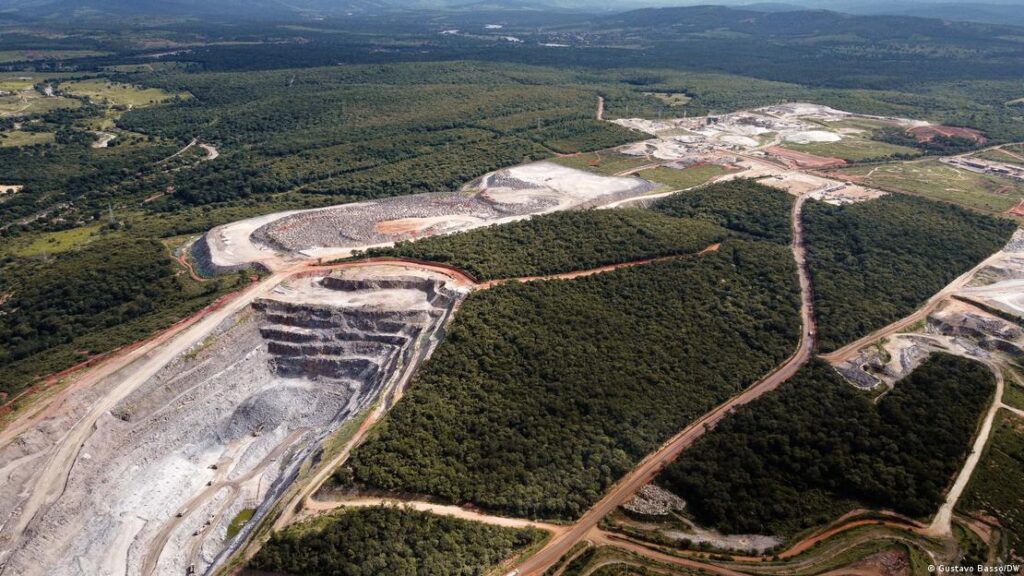
The EU is eyeing easier access to Brazil’s vast mineral reserves as it races to reduce reliance on China for the raw materials used to power green technology and build weapons. Lower tariffs could see Brazilian exporters boost business with Europe.
The country accounts for roughly 10% of global aluminium extraction, 13% for graphite and 16% for tantalum. It also dominates the world market for niobium, a metal used in everything from steel production to the superconducting magnets in the world’s largest particle accelerator, the Large Hadron Collider (LHC) near Geneva, Switzerland.
But more incentives for mining are just one of the reasons climate campaigners oppose the deal, which they also warn will drive Amazon deforestation and destroy ecosystems.
Short-term win for the auto industry?
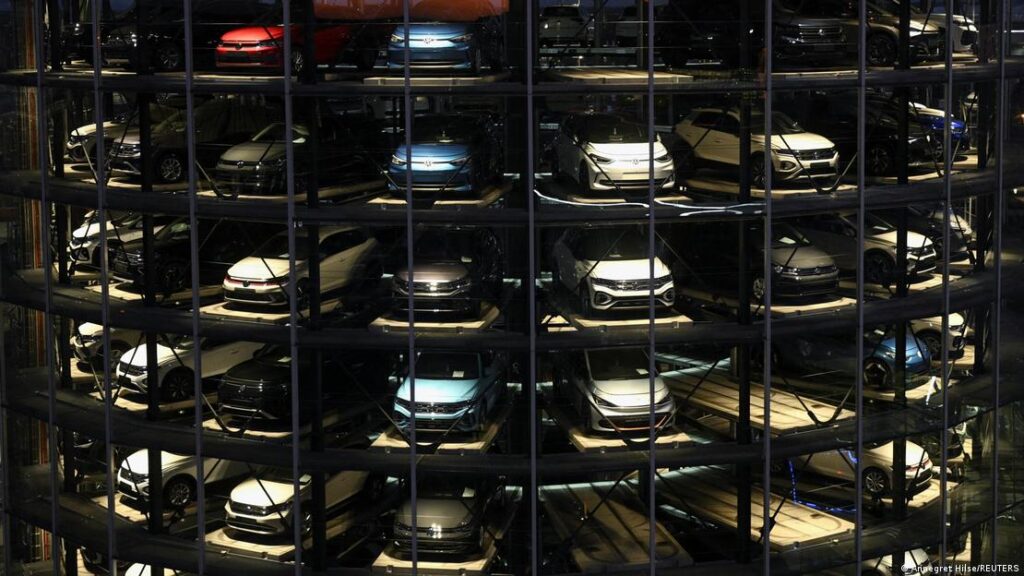
Germany’s auto industry is seen as the major winner on the European side, as car suppliers search for more customers to cushion the blow of US duties and dampened Chinese demand.
“It’s of utmost importance to find new markets,” Matthias Zink, CEO of German car component manufacturer Schaeffler’s powertrain and chassis division told DW last month.
“There will be growth outside the established markets. There will be growth in Brazil, in India, in Southeast Asia,” he added.
But one part of this equation cited less frequently by car manufacturers is their scramble to find markets with less regulation to sell more polluting gas and diesel cars in the future. An EU ban on sales of most new gas and diesel vehicles is set to come into effect 2035, although the bloc had already watered down provisions.
Bypassing France
The cheer of German carmakers did little to quell anger from Europe’s farmers, who claim they’re getting a raw deal. “The EU wants to save German and European industries at farmers’ expense,” one demonstrator, who declined to be named, told DW during a rally in Brussels last month as tractors piled potatoes to block the streets behind him.
In the last year, the EU’s executive added new “safeguard” measures to limit imports of South American meat and avoid unfair competition, but those failed to convince the bloc’s most skeptical member, France.
Poland, Ireland, Austria and Hungary also opposed the pact over agricultural concerns — but were overruled in a vote last week.
Though some big-ticket decisions like sanctions can be vetoed by any EU state, EU trade policies only need backing from a so-called qualified majority of members.
It’s rare to see the EU make a major move without France’s backing. In Brussels, that’s seen both as proof the bloc can act despite divisions — and a sign that more political battles are in store.
Trump spurs new era in EU trade
Saturday’s signature may signal a trade turning point for Europe: Officials are also pushing ahead other agreements once stalled over climate or agricultural standards.
Last year, Brussels inked a decade-old deal with Indonesia — and before the end of the month, von der Leyen is likely to announce another trade pact with India.
Inu Manak, a senior fellow with the US-based Council on Foreign Relations says that’s part of a broader trend.
“There has been a notable shift among all US trading partners thinking about where they can diversify their trade links,” she told DW.
“I don’t think that the [US] administration has thought that hard yet about what it means to have more fragmentation in the global economy because of their actions.”
Chinese competition
Manak says stiff competition for global influence is shifting the balance of power toward Europe’s Asian and South American partners, which were once seen as “rule-takers.”
“What we’re seeing now is that they’re saying, ‘Well, maybe we don’t have to take those rules,'” she explained.
“Countries say: Why would we do all these things with you when we can get a better deal if we work with China, for example? And they don’t have as many conditions.”
Source: DW

