

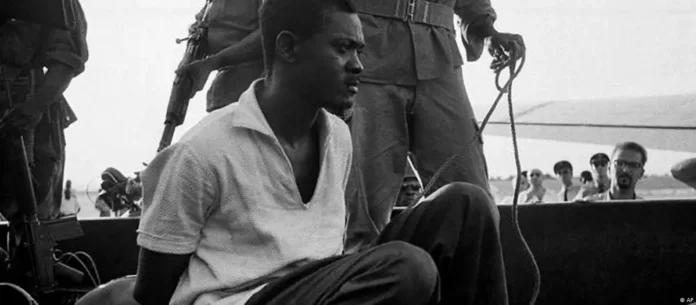

The past is catching up with 93-year-old Etienne Davignon, a former Belgian diplomat accused of war crimes.
On January 20, judges at the Brussels Criminal Court’s Council Chamber heard his legal defense in an attempt to prevent a trial against him for his alleged role in the 1961 killing of Congolese politician Patrice Lumumba.
The Congolese leader fought for the Congo’s liberation from Belgian colonial rule. He remains a symbol for speaking out against injustice and highlighting the violence and humiliations of Belgian rule. He was tortured, shot and mutilated because of his beliefs, and his body was then dissolved in an acid bath.
Davignon is the only suspect in the crime who is still alive. He was one of 10 Belgian officials named in a 2011 complaint filed by the family of Patrice Lumumba. This led Belgian prosecutors to investigate the assassination of the Democratic Republic of Congo’s first democratically elected prime minister.

After more than a decade of on-and-off investigation, Belgian prosecutors asked for the case to be sent to Brussels criminal court in June 2025, citing Davignon’s suspected role in war crimes committed in Congo.
Can Lumumba’s killing still be brought to court after 65 years?
The prosecution of international crimes such as genocide, crimes against humanity and war crimes has no time limit, meaning they cannot expire or be covered by amnesty. This is why cases like the killing of Lumumba can still be investigated decades later.
Wolfgang Kaleck, general secretary of the European Center for Constitutional and Human Rights (ECCHR), says the assassination of Lumumba “is one of the most damaging political murders of the last century.”

“This kind of violence is committed not only by individuals but also an apparatus. It’s a division of labor, so everybody played his role,” Kaleck told DW. “I have complete comprehension for everybody who argues that Etienne Avignon was young then. But still, he was an elite diplomat, he was amongst the Belgian elites.”
Lumumba’s assassination threw the Congo into decades of dictatorship under Mobutu Sese Seko, who seized power in a coup, clinging to power until 1997.
Lumumba’s legacy honored
Members of the Congolese diaspora in Belgium are following the case attentively and demanding justice. Members of the Colonial Memory and Anti-Discrimination Collective gathered in Brussels on January 17, 2026, to mark 65 years since the assassination of Lumumba.
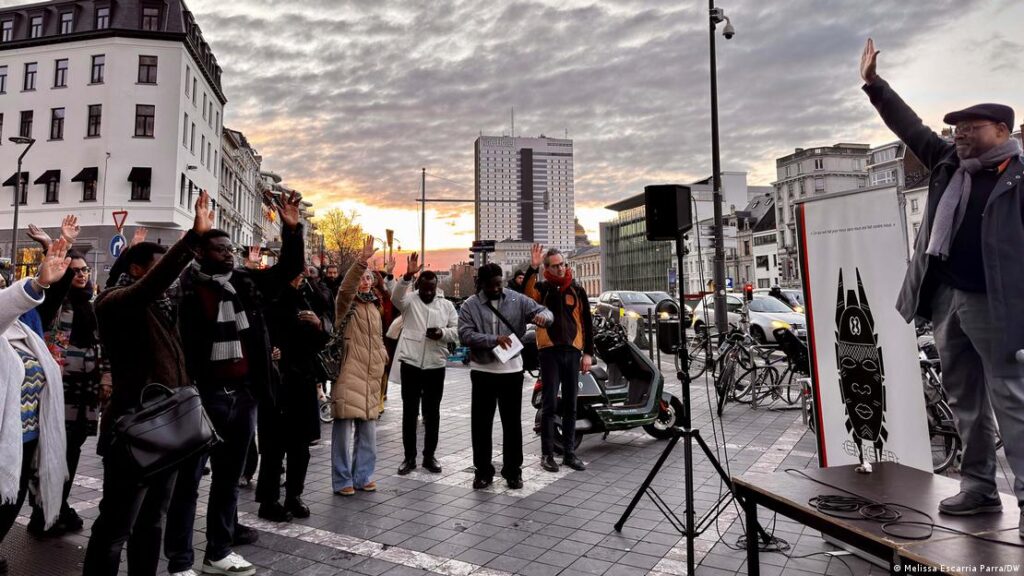
“Patrice Lumumba is a political role model of victory through resistance against imperialism and colonial power,” said Stephanie Ngalula, the event’s organizer.
Even though the Belgian state acknowledged its moral responsibility for Lumumba’s killing in 2001 and apologized to his family in 2022, Ngalula said Belgium has not done enough to repair the damage caused by its colonial past.
“Whenever Belgium has had the chance to speak out against colonialism and abuse, it has missed it and has even contributed to maintaining the status quo,” added the activist.
Historic war crimes revisited
Davignon was working as an intern at Belgium’s foreign ministry at the time of the murder. The charges against him include Lumumba’s illegal detention and transfer, the denial of his right to a fair and impartial trial, and humiliating and degrading treatment.
Before the 2011 criminal complaint filed by Lumumba’s family, the Belgian lower house of parliament, the Chamber of Representatives, had set up a parliamentary inquiry commission in 1999. The commission’s report, published two years later, said Davignon was “tasked with convincing then-Congolese President Joseph Kasa Vubu to dismiss Lumumba [as prime minister] and providing him with the necessary legal arguments.”
Stephanie Ngalula said putting Davignon on trial would send a clear message to the Congolese people: “One cannot, without consequence, assassinate the prime minister of a sovereign state in his own country without repercussions.”
In the coming weeks, the judges of the Brussels Criminal Court’s Council Chamber are expected to decide whether to bring the case against Davignon to trial. Belgian authorities said the next hearing is scheduled for March 17, 2026. And the ECCHR’s Kaleck added that Lumumba’s family is thinking about filing a civil complaint against the Belgian government if Davignon dies, or is not taken to trial.